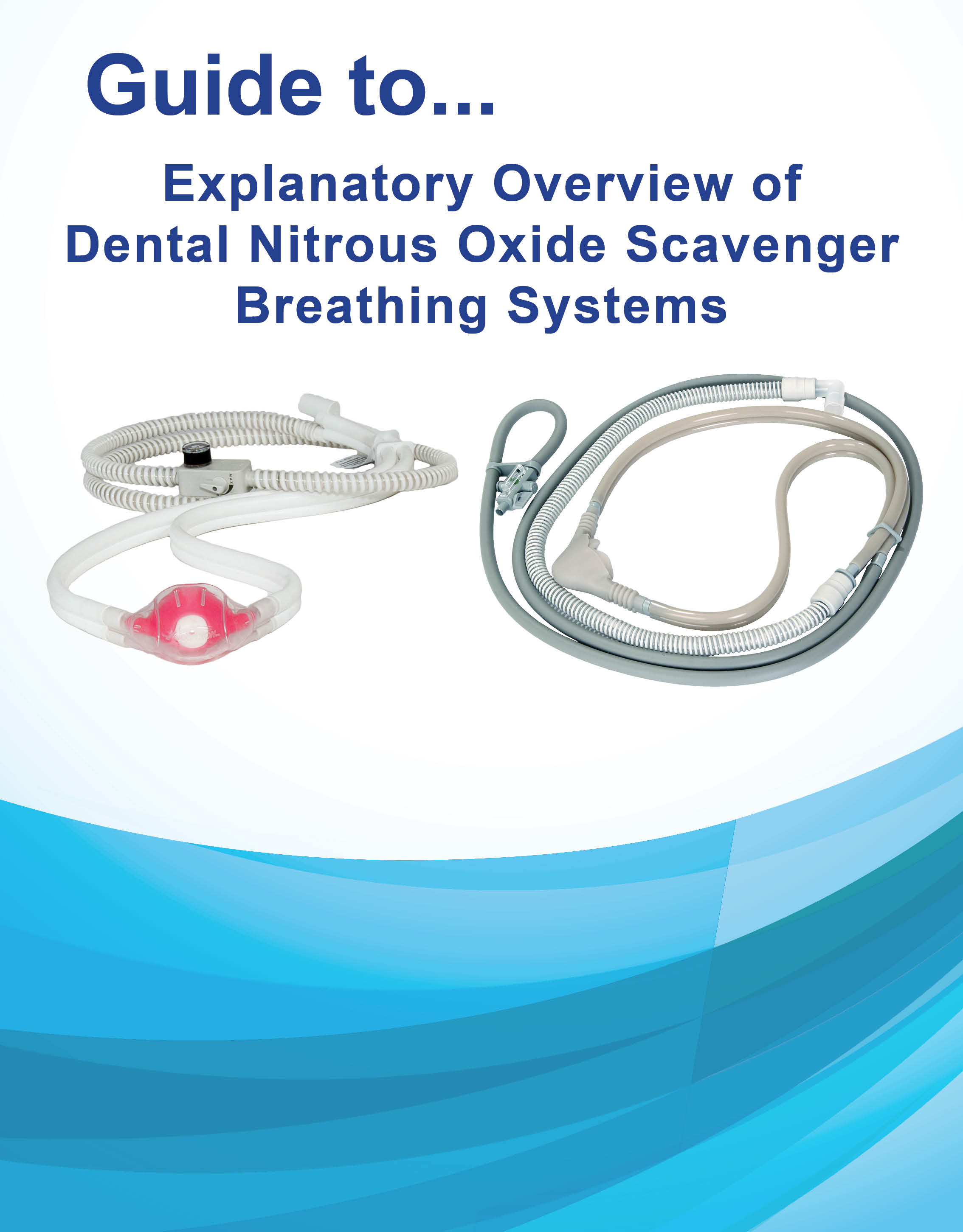
The single most important step in reducing ambient nitrous oxide in a dental surgery is the use of an efficient scavenging system. The NIOSH Technical Report Control of Nitrous Oxide in Dental Operatories puts the reduction at around 90% with an efficient system. But “efficient” is doing a lot of work in that sentence. This guide sets out the scavenger breathing systems that have been on the UK marketplace, with the features, infection-control considerations and connection options for each — and an explanation of why the passive type is now obsolete. The companion Scavenging of Nitrous Oxide guide covers the wider compliance, monitoring and exposure-limit side.
What you'll learn
- Define active and passive scavenging, and explain why passive systems are now obsolete.
- Compare the Porter Brown, Matrx ANS and Accutron active systems on efficiency, infection control and ease of use.
- Understand the difference between extraction flow rate and induced flow rate, and why it matters for AGSS connections.
- Connect an active dental breathing system to an AGSS wall terminal without an air break.
- Choose between a dental vacuum, an AGSS terminal with probe adapter, and a Miniscav unit for venting waste gas.
The current UK recommended exposure limit for nitrous oxide is 100 ppm (parts per million) over an 8-hour time-weighted average (TWA). There are three practical ways to comply with this:
- Use an efficient active scavenger breathing system with an air flow rate of 45 L/min at the nasal mask.
- Provide 12–15 room air changes per hour, or another form of ventilation such as a low-level expelair fan.
- Rotate staff to limit individual cumulative exposure.
The single biggest contributor is the first item — and the most cost-effective. The NIOSH figure of around 90% reduction in ambient nitrous oxide with an efficient scavenging system is a real-world number, measured in working dental surgeries. The practical implication is that a practice that gets the scavenging right and has a basic diffusion-pen check annually will comfortably pass a COSHH assessment, with margin to spare.
Modern dental scavenger breathing systems fall into two distinct types — active and passive. The passive type is now obsolete, but it is still in service in a small number of older surgeries, and is included here for teaching purposes.
Passive systems — the original type, manufactured by Matrx and on the marketplace for over 40 years. The system consisted of 22 mm clear corrugated hoses with a one-way valve. Gas passed from the fresh-gas outlet (22 mm) along the tubing to a nasal hood on the patient’s face, with a blanking cap to prevent the escape of waste gases. The nasal hood could be either the blue (originally grey) autoclavable hood or a Dynomite scented single-use hood. On expiration, a valve opened in the expiratory hose, and the expired air was forced out, by the patient’s own respiratory effort, into a further length of tubing. The tubing was typically ‘hung’ out of a window or connected to a low-level wall exit vent block. Later installations connected it to a wall-mounted AGSS (Anaesthetic Gas Scavenging) system such as a MEC Purair 130 or Dental 2000. These AGSS units needed to be mounted no higher than one metre above floor level to have any efficacy. The transfer hose from the patient had to be level or slope downwards, to assist the flow of waste gases (nitrous oxide is heavier than air). If the receiver was mounted high on the surgery wall, back-flooding of gases could occur.
The hard upper limit on the air flow rate at the nasal mask in a passive system is around 0.5 L/min (BS 6834:1987) — well short of the 45 L/min target for an effective active system. The system was not efficient, with a real risk of significant waste-gas leakage and ambient surgery pollution.
Historical note: in January 2009, Porter Instruments announced they had purchased the Matrx Nitrous Oxide Division from Midmark. All manufacturing was transferred to the Porter factory in Hatfield, Philadelphia. In January 2010, Porter announced that they were discontinuing the Passive breathing system with immediate effect. The system is now obsolete and no parts are available. If your surgery is still running one, it should be replaced.
The Porter Brown is a double-mask system and is proven to be the most efficient of the active systems on the UK market. (Ref 1: Clinical evaluation of the efficacy of three nitrous oxide scavenging units during dental treatment, Certismo, Walton, Hartzell, Farris, General Dentistry September–October 2002.)
The system consists of a corrugated hose connected to the fresh-gas outlet (22 mm) passing via coaxial hose to the inner liner. As the patient breathes out, a flapper valve opens in the inner liner, and the gas passes to the outer hood, where it is collected and passed down a second set of coaxial tubes to a vacuum hose. The gap between the inner liner and outer hood is a deliberate feature: pollution caused by mouth-breathing or speaking is reduced, as a percentage of the waste gases are ‘sucked’ back into the hood and exhausted via the vacuum hose. There is an adjustable vacuum control block on the end of the vacuum hose (this block is designed to operate in the vertical position, not horizontal), which allows the air flow rate to be adjusted to 45 L/min. The unit is autoclavable and latex-free. The system is designed to be connected to either a central suction, an AGSS wall outlet (special probe / adapter required), or a Miniscav unit.
Most efficient system currently available on the UK market, and by some margin the most widely used.
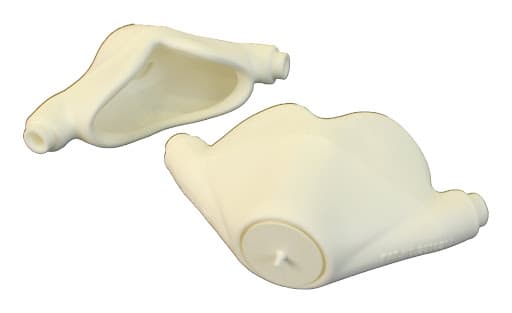
The Matrx ANS (Autoclavable Nitrous Scavenger) was introduced by Matrx to address the infection-control issues of the earlier active system, which had reinforced spiral hosing that was difficult to clean. The ANS has smooth white tubing (which can show dirt easily) and a collector cap over the nasal hood (which can be noisy). It uses a single tube from the fresh-gas outlet (22 mm) to the nasal hood (blue autoclavable or single-use scented), with the gas collected via a ‘mushroom cap’ with valving that directs it to a further length of vacuum hose. The system is designed to connect to central suction. Manufacture continues as part of the Porter range.
The ANS replaced the older Matrx active system on infection-control grounds, but it has not proved popular in the UK, even though it has been modified to better balance the nasal hood and collector cap arrangement. The main practical issue is with the use of a conventional single nasal mask — leakage around the nose, and lower efficiency than the Porter Brown double-mask design.
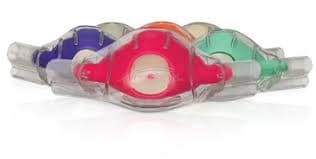
The Accutron system has a grey corrugated hose from the fresh-gas outlet (22 mm) to white coaxial tubing. Fresh gas passes up to the nasal hood (grey multi-use or scented single-use, now available in single and double (Clearview) versions). Exhaled gases are collected via a clear collecting cap (can be noisy) and pass down a distal set of coaxial tubes to a vacuum line designed to connect to central suction. The system also has a vacuum control block that can be adjusted.
The Accutron system is a good choice if you want to use scented nasal hoods. Historically, there have been some problems with the multi-use hoods and collector-cap material warping after autoclaving at British autoclave temperatures — Accutron appears to have corrected this fault. As with the Matrx ANS, the use of a single nasal mask type is less efficient than the Porter Brown double-mask design.
Connecting an active scavenger breathing system to an active vacuum source is a common source of confusion. The NIOSH definition is unambiguous:
> “Exhaust ventilation of nitrous oxide from the patient’s mask should be maintained at an air flow rate of 45 L/min, measured by a calibrated flow device, and vented outdoors.”
This can be achieved in one of three ways:
- A suitable dental vacuum system, connected to the high-volume port.
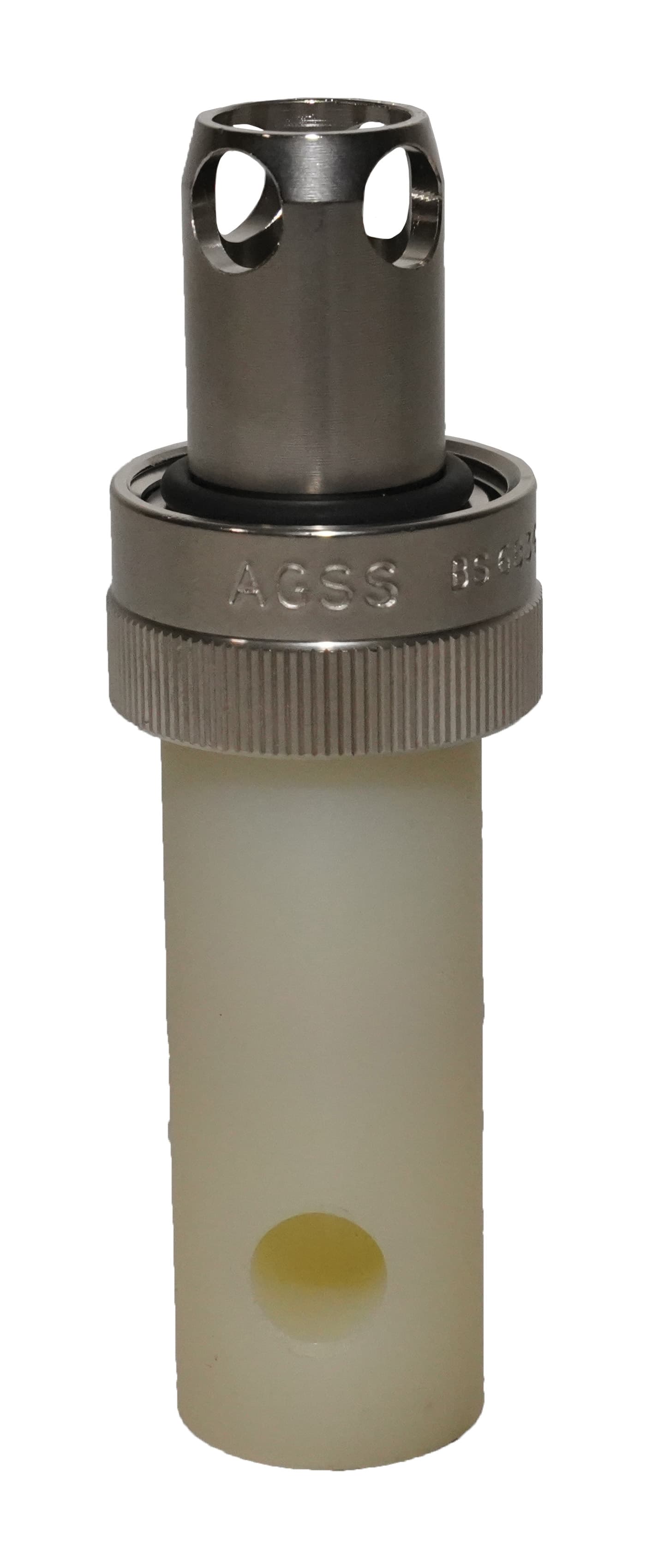
- A centralised AGSS wall outlet, used with a special probe adapter and without an air break (Barnsley receiver).
- A Miniscav unit.
The trap is the air break. Air breaks (also called Barnsley receivers) prevent transmission of suction from the exhauster unit to the patient. They are not suitable for use with dental active breathing systems. An example is the MEC Purair 130 (or MEC Dental 2000), which uses a tubular receiver / air break. The role of the receiving unit is to provide a safe interface between the patient and the extraction flow rate — designed originally for G.A. circuits, to protect the air flow of the unconscious patient. The receiver is fine for a passive breathing system, which is not capable of sustaining a 45 L/min flow rate anyway, and which is now obsolete.
Extraction flow rate operates between 130 and 80 L/min (BS 6834:1987 — replaced by BS EN 737-2:1998, which has an extraction flow rate of 25 to 50 L/min). It is to ensure that waste gases are adequately removed from the surgery. If the extraction flow rate falls too low, waste gases may spill out of the base of the receiving unit reservoir into the working environment.
Induced flow rate, primarily for use with G.A. circuits, should be as low as possible, with the system ideally being passive between the patient and the receiving unit, and active from the receiving unit to the exhaust point. The induced flow rate can be as low as 0.5 L/min (BS 6834:1987) or 0.05 L/min (BS EN 737-2). The induced flow is the level of fresh-gas flow that the receiving system is actively sucking on the patient circuit — which is the source of the confusion. The Purair 130 and 2000 are termed ‘active’ systems, which leads users to assume that a dental breathing system connected to one is also ‘active’. This is not the case. The only dental breathing system suitable for connection to a Purair 130 or 2000D is the Matrx Passive type — and that system is now obsolete.

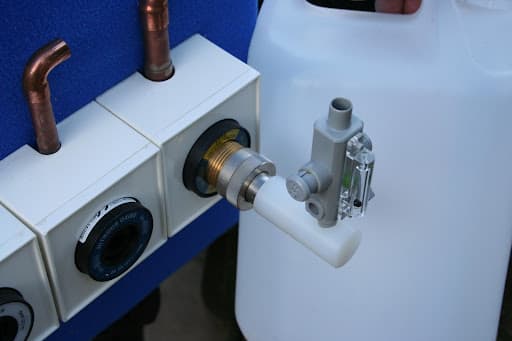
All the active breathing systems described above (Porter Brown, Matrx ANS, Accutron) have been designed by their manufacturers to be connected to a dental vacuum system capable of generating enough flow to operate at the recommended 45 L/min. This usually means occupying the high-volume suction (HVE) port — which is a problem, as most dental surgeries only have one HVE port. Some chair manufacturers (ADEC is the most prominent) now provide a dual HVE option on certain models, which addresses the issue at source. The other main criterion is that the system is vented outside the surgery and the building. Tridac (Aspirade) suction models are not recommended, as the exhausted gases are exposed to motor arcing.
If the dental vacuum system is not suitable, the alternatives are:
- Connection to a centralised AGSS wall outlet, via a special probe adapter. These AGS / probe adapters are designed to locate directly into the AGS outlet and do not require an air break (Barnsley receiver) in the circuit. They must be used with an active dental breathing system capable of being adjusted to 45 L/min by a suitable flow limiter (vacuum control block) integral to the system.
- Connection to a Miniscav active scavenger unit, requiring an electrical socket and an external exit vent (15 mm). The vent should have a downturn on the outside, with an insect filter. Again, must be used with an active dental breathing system.
The practical decision
For most single-surgery practices, the Miniscav is the simplest option. No AGSS terminal is required. No air-break problem. No terminal placement puzzle. The waste gas is vented through a 16 mm wall fitting and the surgery plumbing is the standard medical gas pipeline plus a standard 240 V socket.
For larger facilities with an existing AGSS, the AGSS terminal with probe adapter works well, but the terminal placement has to be planned in detail before the cabinetry is installed. The full details are in the Interfacing Inhalation Sedation Equipment guide.
Key takeaways
- Active scavenging is mandatory for any modern UK dental practice. Passive systems are obsolete and should be replaced.
- The 45 L/min flow rate at the nasal mask is the figure to design around. Below this, the scavenging is not effective.
- The Porter Brown double-mask system is the most efficient active system on the UK market. The Matrx ANS and Accutron systems are reasonable alternatives but less efficient.
- Air breaks (Barnsley receivers) limit the flow rate to 0.5 L/min and are not suitable for use with active dental breathing systems.
- Three practical venting options: dental vacuum (HVE), AGSS wall terminal with probe adapter, or a standalone Miniscav unit.
References
- Certismo R, Walton JN, Hartzell JW, Farris J. Clinical evaluation of the efficacy of three nitrous oxide scavenging units during dental treatment. General Dentistry. September–October 2002.
- NIOSH (1994). Control of Nitrous Oxide in Dental Operatories. NIOSH Technical Report. Cincinnati: National Institute for Occupational Safety and Health.
- British Standards Institution. BS 6834:1987. Specification for active anaesthetic gas scavenging systems.
- British Standards Institution. BS EN 737-2:1998. Anaesthetic gas scavenging systems.
- Department of Health (2006). Medical Gas Pipeline Systems. HTM 02-01. DH, London. Chapter 10: Anaesthetic Gas Scavenging Disposal Systems.
Originally issued as Rev 7 (November 2013) by R A Medical Services. Converted to a guide format for the R A Medical website and updated for the 2026 catalogue.


