
Cross-infection control for inhalation sedation equipment is a critical part of practice compliance. This guide walks through the equipment used during relative-analgesia sedation, the disposable and autoclavable components, and the decontamination steps your practice should be following between every patient. The original content was developed with input from a registered dental nurse with a Certificate in Dental Sedation Nursing, and has been re-published by R A Medical with all third-party magazine branding removed.
What you'll learn
- Understand the importance of cross-infection control for relative-analgesia equipment.
- Explain the equipment used during sedation: nasal hood, fresh gas hose, mixing head/flowmeter.
- Identify which items are single-use disposable and which are reusable autoclavable components.
- Build a decontamination checklist that covers the whole inhalation-sedation unit between patients.
Cross-infection control for inhalation sedation equipment sits alongside your standard surgery decontamination protocol — but it has its own quirks that catch practices out.
The breathing system sits in the patient's mouth and nose. The fresh gas hose carries the gas mix to the nasal hood. The mixing head and flowmeter dials are touched by the operator during every procedure. Every one of these is a potential transmission route if it is not cleaned, disinfected or replaced between patients.
The good news is that the equipment is modular: most of the patient-contact parts are either single-use disposable or autoclavable. The trick is knowing which is which, and making sure your team is following the same protocol every time.
Before you can decontaminate the unit, you need to know what is touching the patient:
- Nasal hood or mask — sits over the patient's nose. Available in adult and paediatric sizes.
- Connecting tubing — links the nasal hood to the breathing system.
- Fresh gas hose — carries the oxygen / nitrous oxide mix from the flowmeter to the nasal hood.
- Waste gas / exhaust hose — carries exhaled gas to the scavenging system.
- Mixing head or flowmeter — the unit itself, including the flow tubes, mixture control and reservoir bag.
Which of these are disposable, which are autoclavable, and which should be wiped but not immersed varies by manufacturer. Always check the manufacturer's instructions for the specific models in your practice.


Modern breathing systems are designed so that the patient-contact parts are either single-use or fully autoclavable. A typical setup might include:
Single-use disposables (replace between every patient):
- Nasal hoods / masks (where the manufacturer does not support autoclaving)
- Hood inner liners / scent pads
- Breathing-system filter (if fitted)
Reusable autoclavable components (decontaminate between patients per manufacturer's cycle):
- Autoclavable nasal hoods
- Connecting tubing
- Reservoir bag (where rated for autoclaving)
- Corrugated hoses
Wipe-clean only (do not immerse):
- Flowmeter body
- Mixture control / flow control knobs
- Pipeline connections
The key rule: if it touched the patient, it needs to be either replaced or reprocessed. The flowmeter body is the one exception — it sits behind the breathing system and does not normally make patient contact.


Your practice protocol should cover the following steps between every patient:
- At the end of the procedure, dispose of single-use items (nasal hood, inner liner, filter) into the clinical waste stream.
- Disconnect the breathing system from the flowmeter following the manufacturer's quick-release procedure.
- Autoclave the autoclavable components (tubing, hood, reservoir bag) per the manufacturer's validated cycle — typically 134°C for 3–4 minutes in a vacuum autoclave.
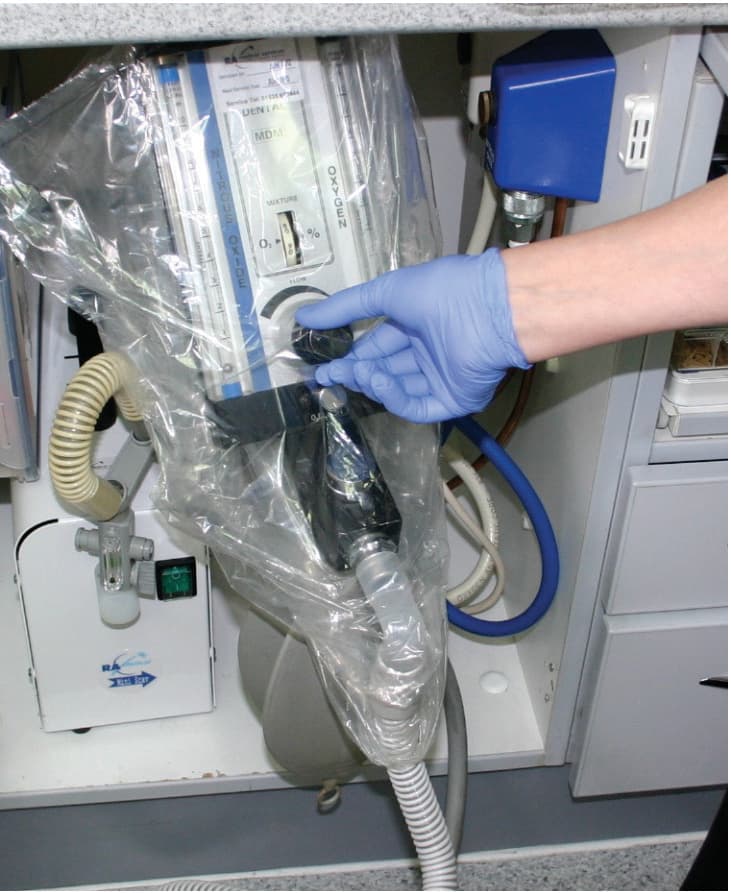
- Wipe down the flowmeter body and stand with a cloth that is damp but not wet, using a cleaning product compatible with the equipment. Avoid spraying directly onto the flowmeter. Avoid alcohol- or bleach-based wipes — both damage flow tubes, diaphragms and decals over time.
- Refit a fresh breathing system before the next patient.
- Document the cycle in your equipment log. Most practices use a pre- and post-use checklist signed by the nurse.
Tip: keep a laminated quick-reference card next to the flowmeter so the whole team is working to the same protocol. R A Medical can supply a pre-use checklist template on request.


We see the same handful of mistakes in practices that have a decontamination issue:
- Using pre-moistened wipes that are too wet. Excess moisture can enter the flow tubes and damage the diaphragms. Always squeeze out excess liquid before applying. This is the single most common cause of avoidable equipment damage.
- Spraying cleaning products directly onto the flowmeter. Spray onto a cloth first, then apply.
- Using alcohol- or bleach-based cleaners. These strip the decals and pit the metalwork on flowmeters and stands. Use a neutral detergent or a manufacturer-approved wipe.
- Reusing disposable nasal hoods. They are single-use for a reason — the inner liner cannot be effectively decontaminated.
- Not documenting the cycle. If you can't show when the breathing system was last autoclaved, you can't demonstrate compliance.
In the UK, the decontamination of reusable medical devices is governed by Health Technical Memorandum 01-05 (HTM 01-05): Decontamination of linen for health and social care. For dental practices the relevant standard is HTM 01-05, which sets out the requirements for cleaning, disinfection and sterilization of reusable instruments.
The key requirements that affect inhalation-sedation equipment:
- A written decontamination policy, reviewed annually.
- A defined cleaning and sterilization pathway for every reusable component.
- Documented evidence of sterilizer validation and maintenance.
- Traceability — the ability to identify which patient was treated with which breathing system batch.
The full HTM 01-05 document is published by the Department of Health and is the authoritative reference. R A Medical can advise on specific scenarios — call us on 01535 652 444.
Key takeaways
- Most patient-contact components are either single-use or autoclavable — know which is which for your specific equipment.
- Wipe the flowmeter body with a damp (not wet) cloth. Never spray directly onto it, and avoid alcohol or bleach.
- Document every decontamination cycle. A signed pre- and post-use checklist is the simplest way to demonstrate compliance.
References
- Department of Health (2013). Health Technical Memorandum 01-05: Decontamination in primary care dental practices. DH, London.
- Department of Health (2003). A Conscious Decision. DH, London.
- British Dental Association. Infection control in dentistry advice sheet.
Originally developed as a sponsored educational supplement in Dental Nursing magazine. Re-published by R A Medical with all third-party branding removed.


